to add an item to your Itinerary basket.


Conan Doyle’s Subterranean Terror.
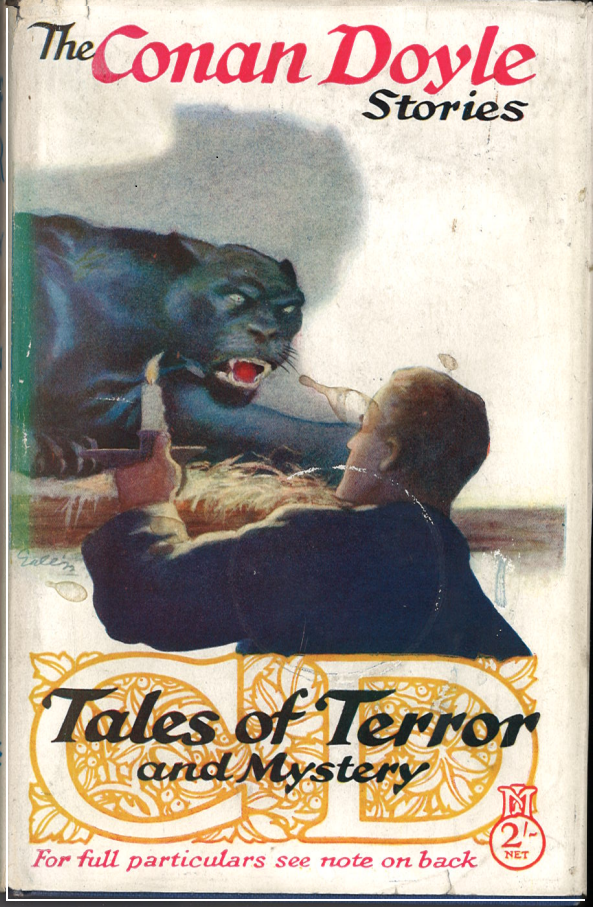
Many people first encounter the work of Arthur Conan Doyle through his iconic Sherlock Holmes stories. But back in the 1970s, I discovered Doyle through his tales of terror and the supernatural. Among these was The Terror of Blue John Gap.
First published in 1910 in The Strand Magazine, the story is written in the form of a diary. Its author is Dr. James Hardcastle, who is recuperating from tuberculosis at a farm in Derbyshire.
Before too long, Doctor Hardcastle begins to explore the local area. He discovers an overgrown, disused mine. Originally established by the Romans, it is known as Blue John Gap. The doctor notes that it was named after ‘Blue John‘ : “…a peculiar mineral of a beautiful purple shade, which is only found at one or two places in the world.“
It is likely that Arthur Conan Doyle was inspired by the Blue John Cavern at Castleton in Derbyshire. Allegedly discovered by the Romans, it is the largest of only two where the Blue John mineral can be found. (The other being the nearby Treak Cliff Cavern, which produced the largest piece of Blue John ever found.) The semi-precious mineral is still mined in a small way and made into jewellery.
Back to the story! Doctor Hardcastle is told of “The Terror that lives in the Blue John Cave.“ But being a professional, educated man, he dismisses this as a local superstition.
Hardcastle descends into the cave to explore it for himself. But disaster strikes when he falls into an underground stream. Without a candle or matches, he finds himself alone in the dark. Then he hears “The tread of some living creature“ :
“My skin grew cold and my hair stood on end as I listened to that steady and ponderous footfall. There was some creature there, and surely by the speed of its advance, it was one which could see in the dark.“
In this scene, Arthur Conan Doyle conjures up a marvellous atmosphere of claustrophobic unease. To be alone in the dark as an unknown creature comes toward you is surely the stuff of nightmares.
After escaping from Blue John Gap, James Hardcastle tells the story of his encounter to the local doctor, who promptly refers him to a psychiatrist. Declining the services of this gentleman, Hardcastle then visits the local police station:
“The inspector entered it all in a large book and bowed me out with commendable gravity, but I heard a burst of laughter before I had got down his garden path. No doubt he was recounting my adventure to his family.“
Undaunted, Doctor Hardcastle returns to Blue John Gap. But this time he is armed with an acetylene lantern, a double-barrelled sporting rifle, and some heavy game cartridges. He must face the creature alone…
I will not give any more of the story away. But suffice to say that the narrative concludes with James Hardcastle’s theory that: “…in this part of England there is a vast subterranean lake or sea, which is fed by the great number of streams which pass down through the limestone.“
Interestingly, the real Blue John Cavern and the Treak Cliff Cavern were both created from deposits on the floor of an ocean that existed there 250 million years ago. One wonders if Arthur Conan Doyle was aware of this.
As to the creature itself, Hardcastle writes that it; “…may well have been the old cave bear, enormously enlarged and modified by its new environment.“ The doctor then hypothesises that: “…there had come some rift in the depths of the mountain which had enabled one creature to wander up and, by means of the Roman tunnel, to reach the open air.“
There is much more to Sir Arthur Conan Doyle than just Sherlock Holmes. He was a fine writer in other genres. His stories of terror and the supernatural are certainly well worth reading - especially this one !
END.
Related
Comments
Comments are disabled for this post.