to add an item to your Itinerary basket.


Doyle’s Dinosaurs.
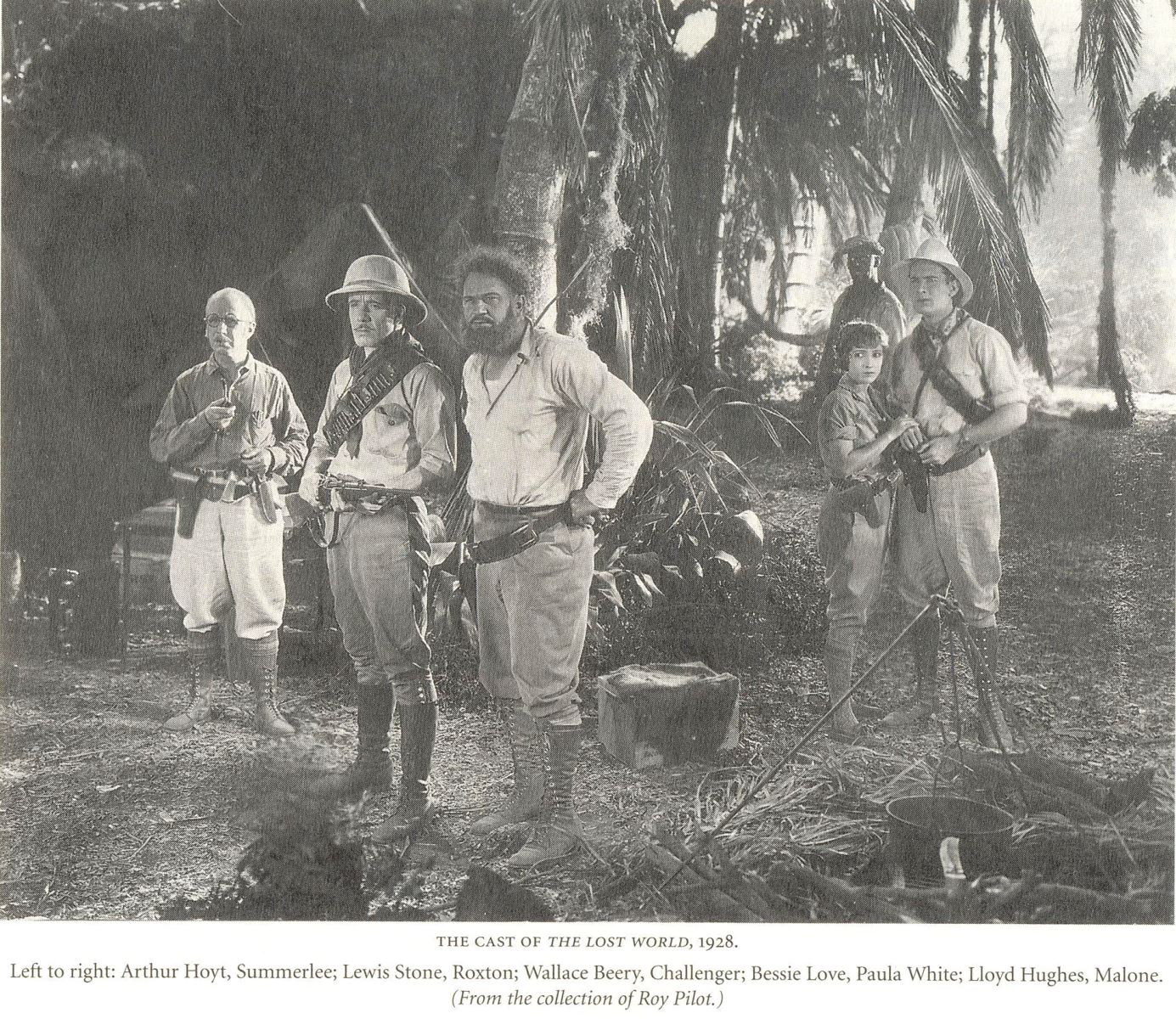
Take an intrepid band of adventurers and put them on a lost plateau in South America. Add prehistoric tribes and some dinosaurs. And there you have the ingredients for Arthur Conan Doyle’s classic story, The Lost World. First published in 1912, Doyle’s novel is still in print today. It has also been adapted for television and cinema, with the first film version dating from 1925.
But what inspired Arthur Conan Doyle to write The Lost World? In his book ‘Conan Doyle. The Man Who Created Sherlock Holmes,‘ author Andrew Lycett gives us a clue; “He had been fascinated by these creatures ever since coming across a fossil dig while out on a walk at Stonyhurst.“ (This was the college in Lancashire where Arthur Conan Doyle was a pupil.)
Arthur Conan Doyle’s interest in dinosaurs was furthered in 1909 after he moved to Windlesham House in Crowborough, Sussex. Doyle wrote to his mother of some “huge lizard tracks.“ These had been found in a nearby greensand quarry; “…I have another expert of the British Museum coming on Monday to advise me about the fossils we get from the quarry opposite.“
The expert was the renowned palaeontologist Arthur Smith Woodward, who was Curator of the Geology Department of the British Museum (Natural History). Strangely enough, little if anything seems to have come from Woodward’s visit.
However, in 1913 a journalist named A. St. John Adcock wrote an article for the Bookman. Entitled ‘Doyle’s Crowborough Home,‘ it claimed that; “…on the floor of the billiard room stood two huge fossil feet of the prehistoric Iguanodon, and on the table above them is the flint head of an arrow that has survived the Stone Age.“
Did A. St. John Adcock really see the fossilised feet of an extinct Iguanodon? Whatever the answer to that question, he definitely credited these findings with helping to inspire The Lost World.
In the novel, Professor Challenger’s small party come across some mysterious tracks:
“Wealden!“ cried Challenger, in an ecstasy. “I’ve seen them in the Wealden clay. It is a creature walking erect upon three-toed feet, and occasionally putting one of its five-fingered forepaws upon the ground. Not a bird, my dear Roxton, - not a bird.“
“A beast?“
“No; a reptile - a dinosaur. Nothing else could have left such a track. They puzzled a worthy Sussex Doctor some ninety years ago…“
The ‘Sussex doctor‘ referred to was probably Gideon Mantell. Born in Lewes in Sussex, Mantell was a physician who devoted his spare-time to palaeontology. In 1822, he discovered some fossilised teeth of an Iguanodon dinosaur. Years later, he bought the remains of an Iguanodon and went on to reconstruct its skeleton. Mantell’s work marked the beginning of the scientific study of dinosaurs.
Another possible inspiration for The Lost World was a strange creature that Arthur Conan Doyle claimed to have seen, while on a Mediterranean cruise with his second wife, Jean. Doyle recalled the incident years later in his autobiography, Memories and Adventures, (1924). It was a fine and calm day as they steamed past the Greek island of Aegina. Doyle wrote that:
“…we were looking down into the transparent depths when we both clearly saw a creature which has never, so far as I know, been described by Science. It was exactly like a young ichthyosaurus, about 4 feet long, with thin neck and tail, and four marked side-flippers.“
Ichthyosaurs were large marine reptiles that roamed the oceans from 250 million years ago to 94 million years ago. They ranged in size from 3 feet to 85 feet in length.
Unfortunately, the ship had passed the alleged creature before anyone else could be summoned to witness it. Interestingly though, Doyle noted a similar incident that had been reported in the Evening News. An Admiral Anstruther had described and sketched a similar creature that he claimed to have seen off the Irish coast.
Arthur Conan Doyle carried out extensive research before he wrote The Lost World. One of the books that he consulted was Extinct Animals, (1905). Written by the zoologist Ray Lankester, it had an illustrated chapter on Pterosaurs. Referred to as Pterodactyl’s in The Lost World, these large flying reptiles feature prominently in the novel. At one point, Professor Challenger’s party discovers a “rookery of pterodactyls“ :
“There were hundreds of them congregated within view. All the bottom area round the water-edge was alive with their young ones, and with hideous mothers brooding upon their leathery, yellowish eggs.“
Toward the end of the novel, Professor Challenger captures a Pterodactyl and brings it back to England. It is unveiled at a meeting in London, as a newspaper report records:
“The cries of the people in the galleries, who were alarmed at the near approach of those glowing eyes and that murderous beak, excited the creature to a frenzy.“
The unfortunate Pterodactyl then moves toward a window:
“In a moment the creature, beating and bumping along the wall like a huge moth within a gas-shade, came upon the opening, squeezed its hideous bulk through it, and was gone.“
In 1994, two palaeontologists found the remains of a new species of Pterosaur in north-eastern Brazil. They named it Arthurdactylus conandoyli in honour of Sir Arthur Conan Doyle and The Lost World.
END.
Related
Comments
Comments are disabled for this post.