to add an item to your Itinerary basket.


Stars In Their Eyes.
“My surprise reached a climax, however, when I found incidentally that he was ignorant of the Copernican Theory and of the composition of the Solar System. That any civilised human being in the nineteenth century should not be aware that the Earth travelled round the Sun appeared to be to me such an extraordinary fact that I could hardly realise it.“
So wrote a shocked Doctor Watson in the first Sherlock Holmes story, A Study in Scarlet (1887). Watson compiles a list of Sherlock Holmes’s limits. Third on the list is ‘Astronomy - Nil.‘
Watson questions Holmes about his lack of astronomical knowledge. But Holmes counters this by saying: “It is of the highest importance, therefore, not to have useless facts elbowing out the useful ones.“
Doctor Watson is outraged: “But the Solar System!“ I protested.
“What the deuce is it to me?“ he interrupted impatiently; “You say that we go round the Sun. If we went round the moon it would not make a penny-worth of difference to me or to my work.“
However, just six years later Sherlock Holmes’ knowledge of astronomy has increased markedly. In The Greek Interpreter (1893), Holmes and Watson are talking after tea one summer evening. Watson recalls that the conversation; “…roamed in a desultory fashion from golf clubs to the causes of the change in the obliquity of the ecliptic…“ (The obliquity of the ecliptic is the tilt of the Earth’s axis relative to its orbital plane.)
Holmes’s creator, Arthur Conan Doyle, also had some knowledge of astronomy. While not an active observer of the heavens, Doyle was still interested in the subject. This increased after he joined the Portsmouth Literary and Scientific Society.
Arthur Conan Doyle became friendly with Alfred Wilks Drayson, who was president of the PLSS. In his book The Captain of the Polestar and Other Tales, Arthur Conan Doyle wrote; “To my friend Major-General A.W. Drayson as a slight token of my admiration for his great and as yet unrecognised services to astronomy this little volume is dedicated.“
Alfred Wilks Drayson (1827 - 1901) rose through the ranks of the army. After attaining the rank of Major-General, Drayson left the service and retired to Southsea in Hampshire. There he devoted himself to writing, astronomy, and other scientific pursuits. Sir Arthur Conan Doyle, in his autobiography Memories and Adventures, recalls Major-General Drayson as; “…a very distinguished thinker and a pioneer of psychic knowledge, who lived at that time at Southsea. I had known Drayson first as an astronomer…“
Drayson was elected as a Fellow of the Royal Astronomical Society in 1868. He was also a keen spiritualist who even wrote a paper titled ‘The Solution of Scientific Problems by Spirits on the moons of Uranus.‘ Published in the spiritualist weekly journal Light, it supposedly contained information obtained during a seance. Alfred Wilks Drayson was the author of a book titled The Common Sights in the Heavens. He also wrote articles on astronomy for the Boy’s Own Paper.
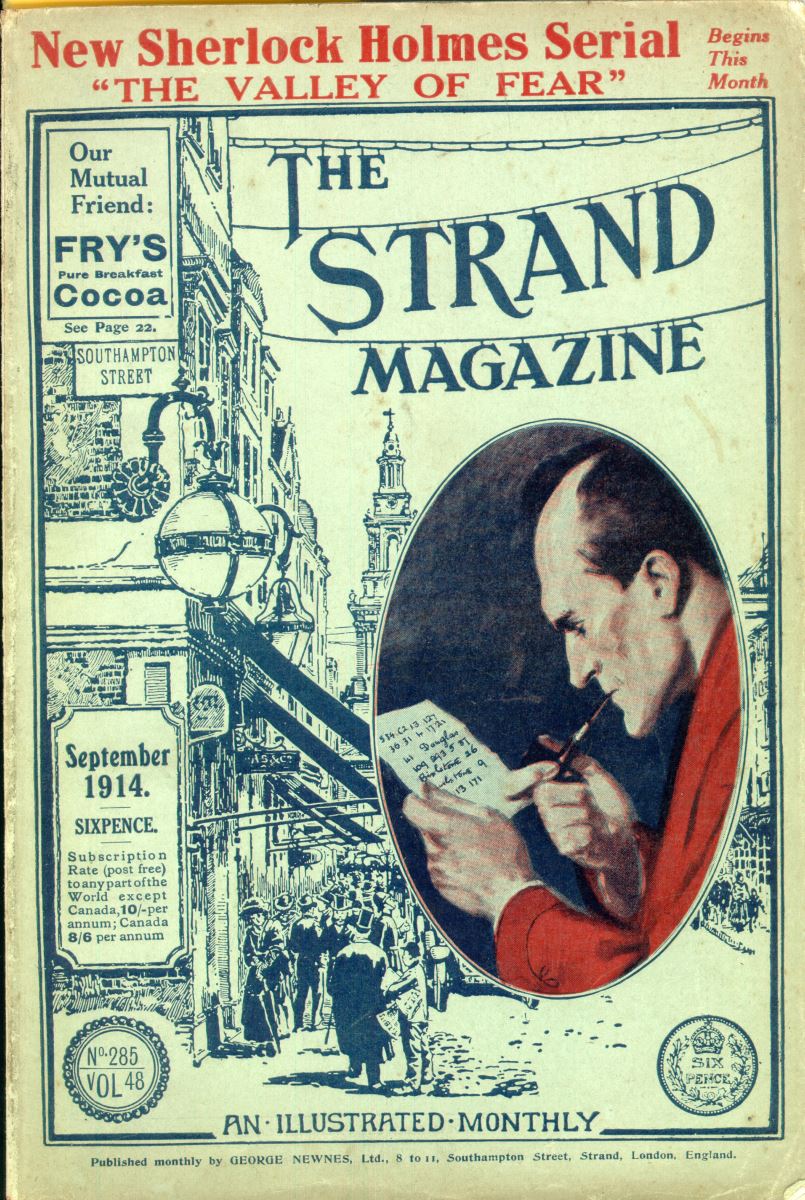
In the novel The Valley of Fear (1915), Sherlock Holmes makes the following remark: “Is he not the celebrated author of The Dynamics of an Asteroid, a book which ascends to such rarefied heights of pure mathematics that it is said that there was no man in the scientific press capable of criticising it.“
Holmes is referring to a work by his arch-enemy, Professor James Moriarty. Written before Moriarty turned to crime, The Dynamics of an Asteroid was probably inspired by real life sources.
One of these may have been a treatise by the German astronomer and mathematician, Carl Friedrich Gauss. Gauss published his treatise on the dynamics of an asteroid named Ceres in 1809.
In 1993, the Journal of the British Astronomical Association published a paper by the astronomer and astrophysicist Bradley E. Schaefer. In this, Schaefer theorises that the astronomer and mathematician Simon Newcomb might have been the inspiration for Professor Moriarty. Newcomb published a series of papers on the dynamics of an asteroid. He was also described as; “…a dynamic and intimidating individual, he was highly successful as a leader, in the sense that he got things done, but he was more feared than liked.“
Bradley E. Schaefer also puts forward a case for Alfred Wilks Drayson as the inspiration for Colonel Moran. Moran is, of course, Professor Moriarty’s right-hand man.
In The Valley of Fear, Inspector MacDonald mistakenly believes that Professor Moriarty is; “…a very respectable, learned, and talented sort of man.“ MacDonald even pays a visit to the Professor: “I had a chat with him on eclipses. How the talk got that way I canna think; but he had out a reflector lantern and a globe, and made it all clear in a minute.“
As an amateur astronomer myself, I have enjoyed finding these references to astronomy in the Sherlock Holmes stories. They are another fascinating example of Sherlockiana.
END.
Related
Comments
Comments are disabled for this post.