to add an item to your Itinerary basket.


By Train With Sherlock Holmes.
When we think of Sherlock Holmes we tend to place him in Victorian London. Seeing a client in his rooms in Baker Street. Then setting off later in a hansom cab with Doctor Watson, as another case unfolds.
However, Holmes and Watson also ventured further afield. In a pre-car society their mode of transport was of necessity by railway. In London they had a dozen mainline stations that served long-distance routes to various parts of the country. These stations included Paddington, King’s Cross, and Waterloo.
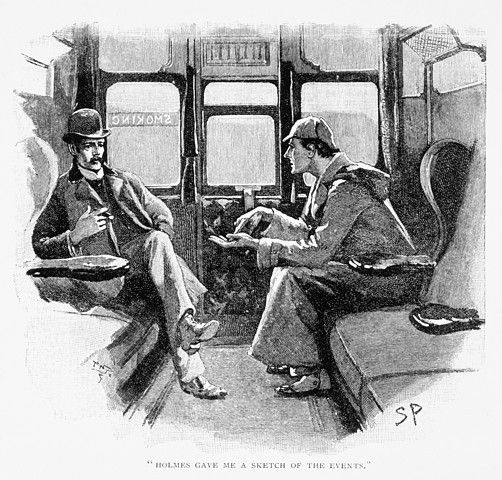
An early reference to travel by railway occurs in The Boscombe Valley Mystery (The Adventures of Sherlock Holmes, 1892). Sherlock Holmes and Doctor Watson leave Paddington Station by the 11:15 train, heading toward Boscombe Valley; “…a country district not very far from Ross, in Herefordshire.“
Never one to waste time while on a case, Sherlock Holmes uses the journey to his advantage. Doctor Watson describes the scene: “We had the carriage to ourselves save for an immense litter of papers which Holmes had brought with him. Among these he rummaged and read, with intervals of note-taking and of meditation, until we were past Reading.“
In Silver Blaze (The Memoirs of Sherlock Holmes, 1893) Holmes informs Doctor Watson of his intention to travel, “To Dartmoor; to King’s Pyland.“ Watson soon finds himself; “…in the corner of a first-class carriage flying along en route for Exeter.“
Watson sees Holmes glancing at his watch; “We are going well,“ said he, looking out of the window, “Our rate at present is fifty-three and a half miles an hour.“
“I have not observed the quarter-mile posts,“ said I.
“Nor have I. But the telegraph posts upon this line are sixty yards apart, and the calculation is a simple one.“
Sherlock Holmes and Doctor Watson travel by train to Winchester in Hampshire in The Copper Beeches (The Adventures of Sherlock Holmes). They have been consulted by Violet Hunter, who is concerned about the bizarre behaviour of her employer, Jephro Rucastle. There is a reference to Bradshaw’s Railway Guide in the story. Holmes asks Watson to, “…look up the trains in Bradshaw.“ Watson replies that; “There is a train at half-past nine…It is due at Winchester at 11.30.“
Bradshaw’s Guide is also mentioned in the novel, The Valley of Fear (1914). Holmes and Watson try to decipher a message from ‘Fred Porlock‘ - a double agent of Professor Moriarty. The code needs to be cracked using a book that everyone is familiar with. Watson suggests Bradshaw, but Holmes disagrees; “The vocabulary of Bradshaw is nervous and terse, but limited. The selection of words would hardly lend itself to the sending of general messages. We will eliminate Bradshaw.“
Bradshaw’s Railway Time Tables and Assistant to Railway Travelling was the brainchild of George Bradshaw (1800 - 1853). Based in Manchester, Bradshaw was a printer, publisher, engraver, and cartographer. His guide was the first ever compilation of railway time tables, together with other information. Though initially restricted to railways in the north of England, it was soon expanded to include the rest of Britain’s rail network.
However, it was a complex task. There were 150 rail companies, all with their own time tables. To add to the confusion, local time was used rather than Greenwich Mean Time. GMT was eventually adopted as the standard time on the railway network in 1847.
Bradshaw’s Railway Guides standardised information for the railway traveller. In 1841, it was published as Bradshaw’s Monthly Railway Guide. Then six years later Bradshaw’s Continental Railway Guide was published, to cover European train travel.
Bradshaw’s Railway Guides finally ceased publication in 1961. However, they have since been given a new lease of life by presenter Michael Portillo in his television series, Great British Railway Journeys.
Sherlock Holmes’s career would have been somewhat limited had it not been for the railways. Armed with his trusty Bradshaw Guide, Holmes could travel to places that would have been beyond his reach otherwise.
END.
Related
Comments
Comments are disabled for this post.