to add an item to your Itinerary basket.


Doyle’s Most Dangerous Machine.
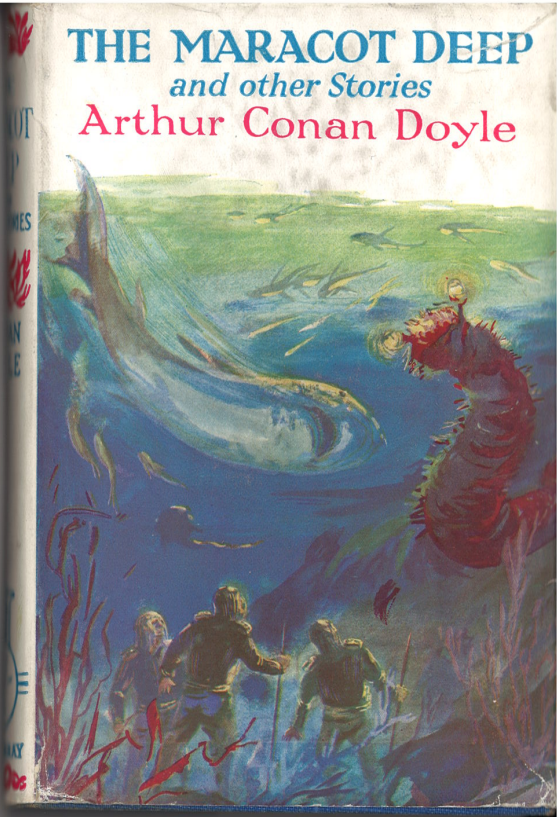
The Disintegration Machine is the last of the Professor Challenger stories written by Sir Arthur Conan Doyle. Originally published in The Strand Magazine in January 1929, it was later included in The Maracot Deep and Other Stories. The Disintegration Machine is not just another tale of scientific marvel. Instead, it is more unsettling than that, and deeply aware of the consequences of invention.
At first the story reads like an adventure. But there is a twist: this is not about dinosaurs or lost worlds. Its about a machine that can literally reduce matter to its component atoms and put it back together again.
The story begins when journalist and acquaintance of Professor Challenger, Ed Malone, is assigned to investigate the claims of eccentric inventor, Theodore Nemor. But Malone needs the help of Professor Challenger. Malone interrupts the Professor as he finishes berating someone on the telephone: “I confronted him as he turned from the telephone - a lion in its wrath. His huge black beard was bristling, his great chest was heaving with indignation, and his arrogant grey eyes swept me up and down as the backwash of his anger fell upon me.“
Professor Challenger and Ed Malone visit Theodore Nemor at his London home. The Latvian inventor then shows them his ‘Nemor’s Disintegrator,‘ which he claims, “…is destined to be famous, as altering the balance of power among the nations. Who holds this rules the world.“
These themes of technological power and global instability later became a mainstay of science fiction. Sir Arthur Conan Doyle could have thrilled us with a dazzling demonstration of a scientific wonder. But wisely he chose instead a more thoughtful approach by considering the impact that such a machine could have upon the world.
Theodore Nemor is certainly in no doubt about the havoc his machine could wreak: “Conceive a quarter of London in which such machines have been erected. Imagine the effect of such a current upon the scale which could easily be adopted. Why,“ he burst into laughter, “I could imagine the whole Thames valley being swept clean, and not one man, woman, or child left of all these teeming millions!“
Sir Arthur Conan Doyle also wisely inserts some humour into the proceedings - thus making the more serious points of the story more accessible. Acting as a human guinea pig, Professor Challenger takes his turn on the machine and promptly vanishes. Ed Malone reports on Challenger’s reappearance - minus his hair and beard: “But what a Challenger! What a shorn lion! Furious as I was at the trick that had been played upon him I could hardly keep from roaring with laughter. Challenger regains his hair and beard after threatening Theodore Nemor: “If in five minutes I am not as I was, I will choke the life out of your wretched little body.“
Doyle cleverly combines a sense of adventure with ethical reflection in The Disintegration Machine. He was already probing the idea that some inventions are dangerous not because they fail, but because they work - and Nemor’s machine works only too well.
As far back as the late 19th century, writers like Edward Page Mitchell imagined machines that transformed bodies and matter in eerie ways, establishing a tradition of scientific creation outpacing ethical control. This was built upon by H.G. Wells in stories like The Land Ironclads, where a breakthrough weapon threatens the balance of power. Sir Arthur Conan Doyle links into this lineage by focusing on character and implication rather than science fiction spectacle.
What is striking about The Disintegration Machine is how it reflects post-First World War attitudes toward technology. The public were more sceptical of scientific progress. Doyle’s story reflects this by questioning whether there are things we ought not to unleash, or at least whether we can be trusted with them. This is something that is still relevant today when it comes to such issues as nuclear weapons and artificial intelligence.
In the end, Challenger and Malone walk away with the world unchanged on the surface. But there is still a nagging sense of unease. The threat embedded in the idea of the machine itself - and in the thought that somewhere out there, someone might yet build something just like it.
END.
Related
Comments
Comments are disabled for this post.