to add an item to your Itinerary basket.


Dancing Around The Moon.
One day in 1871, Arthur Conan Doyle wrote a letter to his father. Part of it read as follows: “You remember that little picture of St Michael’s Mount with Sir Kennelworth on it which you drew in my little red book. Well! The Fathers say it is a most wonderful work of art and have taken it from me they are so delighted with it.“
There is something rather touching about Doyle’s pride in his father’s work and his enthusiasm in passing this on to him. Arthur Conan Doyle was then a pupil at Stonyhurst College in Lancashire. His father, Charles Altamont Doyle, was living with the rest of the Doyle family in Edinburgh.
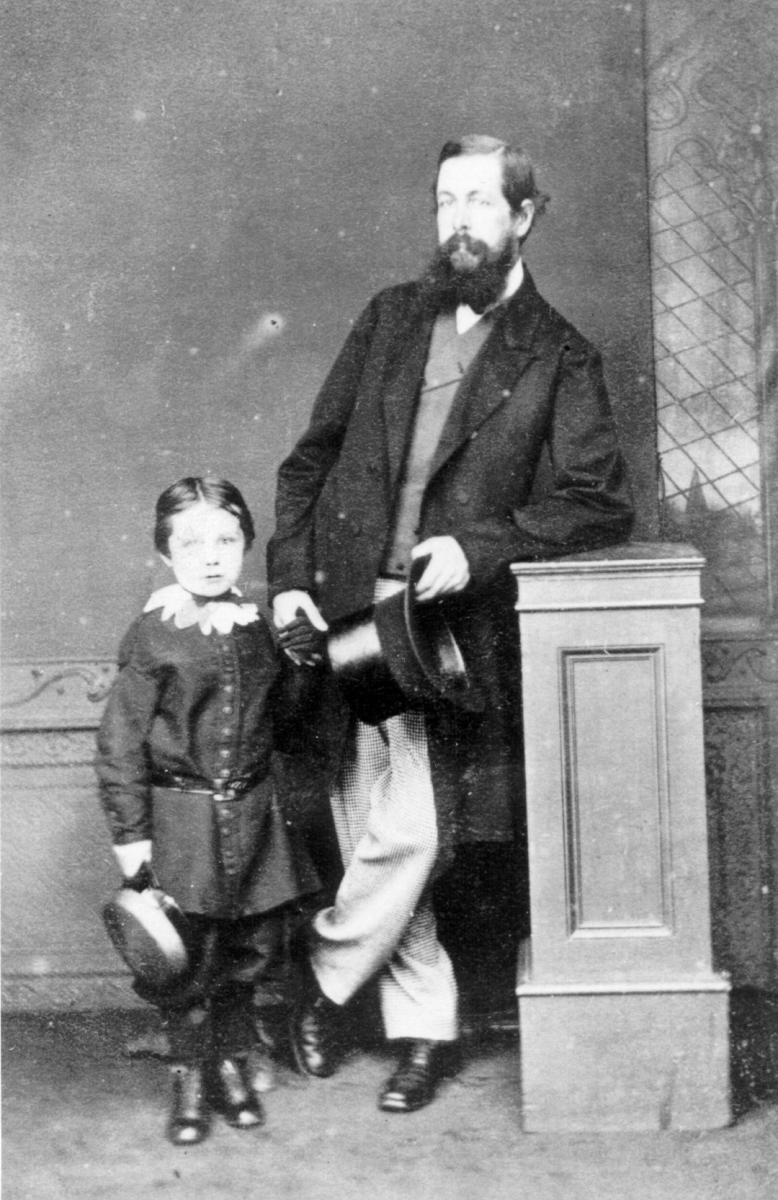
Charles Altamont Doyle was born in London in 1832. His father was John Doyle, a political cartoonist who went under the pseudonym of HB. Charles was the youngest of seven children with three of his brothers - James, Richard, and Henry - destined for successful careers as artists.
Unlike his brothers, Charles moved north to Edinburgh in 1849. There he became an assistant surveyor at the Scottish Office of Works. Charles Altamont Doyle eventually designed such important projects as the fountain at the King’s Holyrood Palace in Edinburgh.
In 1855, Charles Altamont Doyle married Mary Foley. She was one of the daughters of Catherine Foley who was Charles Doyle’s landlady. Charles and Mary went on to produce several children, including Arthur who was born in 1859.
To support his growing family, Charles Doyle produced illustrations for more than 20 books. These included editions of The Pilgrims Progress (1860), Robinson Crusoe (1861), and Beauty and the Beast (late 1860s).
But misfortune struck the Doyle family in the mid-1860s. The head of the Scottish Office of Works retired and the organisation was overhauled. Charles Altamont Doyle was ‘let go.‘ Suddenly unemployed at the age of 44, Charles Doyle turned to alcohol as a solace.
Over the coming years he descended into alcoholism and mental illness. In 1881, his family sent him to Blairerno House in the north of Scotland. But even in this “home for Intemperate Gentlemen,“ Charles Doyle sometimes managed to obtain some alcohol. On one particular occasion in 1885, Doyle got hold of some drink and became “aggressively excited.“ After being restrained, he remained confused and incoherent for several more days.
Charles Altamont Doyle was eventually admitted to Sunnyside, Montrose Royal Lunatic Asylum. By that time he was suffering from severe bouts of depression. The side effects of prolonged and excessive alcohol use were showing, too. His short-term memory was affected and he experienced ‘epileptic seizures.‘ (Or were these perhaps alcoholic fits?)
However, Charles Doyle continued to produce drawings and paintings during his confinement. He produced six pen and ink illustrations for the book edition of the first Sherlock Holmes story, A Study in Scarlet. These were commissioned by its author, Charles Doyle’s son Arthur Conan Doyle.
The illustrations were less than successful. In his book Conan Doyle, The Man Who Created Sherlock Holmes, author Andrew Lycett comments that; “Charles Doyle’s artwork was wooden and appeared to depict himself, lank and bearded, as Sherlock Holmes, as if pleading from the asylum for recognition.“
More successful were Charles Doyle’s paintings. These often feature otherworldly images of fairies, elves, and other mythical creatures. A typical example is ‘A Dance Around the Moon.‘ Done in watercolour with pen and ink, it shows a scene of fairies and other figures as they dance around the Moon.
Another striking picture is titled ‘The Spirits of the Prisoners.‘ This shows fairies, imps, and other creatures falling over the rooftops and down the walls of Montrose Royal Lunatic Asylum.
Charles Doyle’s art was in part a protest against his continuing confinement. He even sent a sketchbook of his drawings to his family, asking them; “Whereabouts would you say was the deficiency of intellect? Or depraved taste? If in the whole book you can find a single evidence of either, mark it and record it against me.“
In 1891, Charles Altamont Doyle was transferred to Edinburgh Royal Infirmary. He died in the Crichton Royal Institution in Dumfries on 10 October, 1893.
Sir Arthur Conan Doyle mounted an exhibition of his father’s works at the Brook Galleries in London in 1924. Further recognition of Charles Doyle’s work came in 1978 with the publication of The Doyle Diary. This is a facsimile of one of Charles Doyle’s sketchbooks dating from 1889 when he was confined in Montrose Royal Lunatic Asylum.
Perhaps the last word should go to Sir Arthur Conan Doyle. In his autobiography Memories and Adventures (1924), Conan Doyle wrote that his father was; “…full of the tragedy of unfulfilled powers and of underdeveloped gifts. He had his weaknesses, as all of us have ours, but he had also some very remarkable and outstanding virtues.“
END.
Related
Comments
Comments are disabled for this post.